Two creators can start with the exact same idea — "a glowing fox" — and end up with two completely different characters. One reads as a warm, retro arcade companion; the other looks like a sleek liquid-metal predator. The difference isn't the species. It's the style: the visual language the art is rendered in. Style is where a neon creature gets its mood, and choosing the right one is the single biggest decision between "a fox" and "my fox."
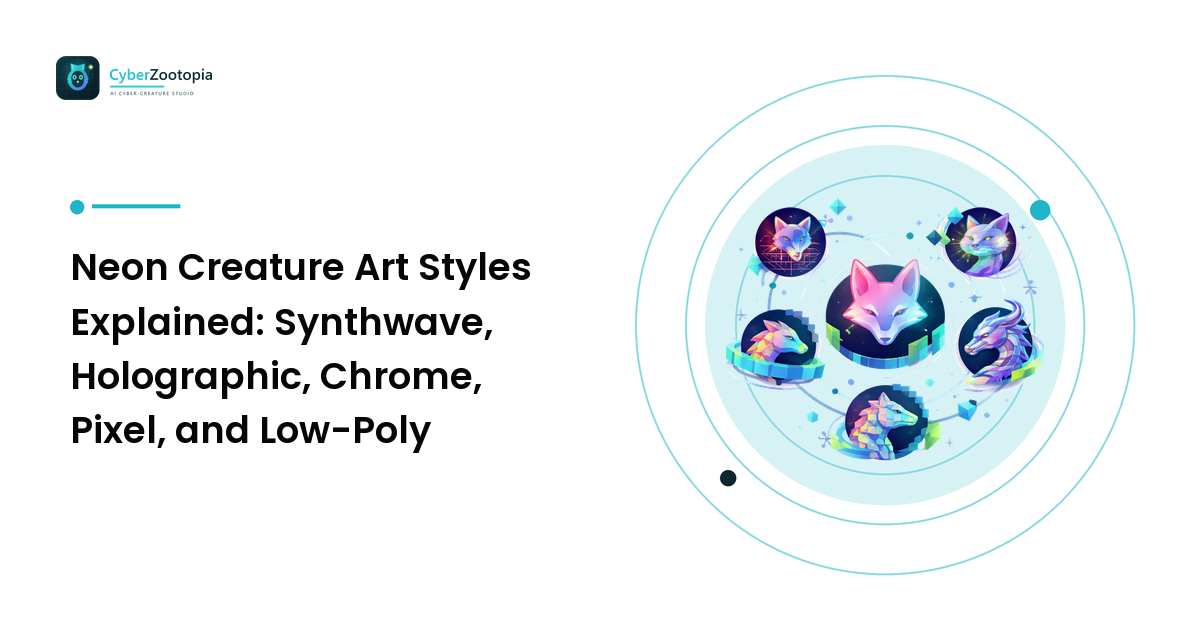
The takeaway up front: style is personality made visual — pick the one whose mood matches the character you want, not just the one that looks coolest in isolation. This guide walks the five neon creature styles you'll run into most — synthwave, holographic, chrome, pixel, and low-poly — what each actually looks like, the feeling it sends, and how to choose the one that fits your creature and your channel.
Why Style Matters More Than Species
People assume the species does the heavy lifting: pick a dragon and you look fierce, pick an axolotl and you look friendly. Species sets the baseline, but style is what tempers it. A dragon rendered in soft synthwave pinks reads playful and retro; the same dragon in cold chrome reads dangerous and expensive. Style is the adjective in front of the noun.
Style also decides where your character can live. Some looks stay crisp when shrunk to a 64-pixel avatar; others turn to mush. Some tile beautifully into an emote sheet; others are too busy. As you read the five below, keep three practical questions in mind:
- What mood does it send — warm and nostalgic, futuristic and clean, cute and playful, sleek and premium?
- Does it survive small sizes for avatars and emotes? (Our avatar design guide covers the readability rules in depth.)
- Is it easy to keep consistent across many poses, so your creature stays recognizable as a community mascot?
The Connective Thread: Neon
Before the five styles, one word ties them all together: neon. Neon isn't a style on its own — it's a palette and a lighting choice that can ride on top of any of the five. It means saturated, glowing color (electric cyan, hot magenta, acid green, ultraviolet) treated like it emits its own light rather than just reflecting it.
The neon signature is the glow: bright edges, a soft bloom of color spilling into the background, and rim-lighting that traces a creature's silhouette in pure hue. That glow is doing real design work — it separates your character from a dark backdrop and makes the silhouette pop, which is exactly what an avatar needs to read at a glance. Every style below can be tuned neon; think of it as the house color language, with the five styles as five different accents.
The Five Neon Creature Styles
1. Synthwave
Synthwave is the retro-future look borrowed from 1980s arcades and sci-fi VHS covers: sunset gradients of pink-into-purple-into-orange, glowing grid horizons, chrome-and-magenta highlights, and a slightly hazy, dreamy finish. On a creature, synthwave usually means warm neon rim-lighting, a gradient body, and that unmistakable "cruising into a digital sunset" mood.
Mood it sends: nostalgic, warm, playful-cool, retro. It feels friendly and fun rather than intimidating.
Great for: cozy streamers, chill/chat channels, retro-gaming communities, and anyone who wants energy without menace. Imagine Volt, a neon fox bathed in pink-to-cyan gradient light — approachable but stylish.
Watch out for: synthwave loves busy backgrounds (grids, sunsets, palm trees). For an avatar, keep the background minimal so the creature stays the subject.
2. Holographic
Holographic (or iridescent) art mimics the shifting rainbow sheen of a hologram sticker or a soap bubble: colors that seem to slide from teal to violet to pink depending on the angle, with a glassy, prismatic surface. On a creature it produces a shimmering, otherworldly finish — like the character is made of light-bending crystal.
Mood it sends: magical, premium, ethereal, a little mysterious. It reads as "special edition."
Great for: dreamy or fantasy brands, VTuber-adjacent creators, and mascots meant to feel rare and collectible. A holographic axolotl looks like a living gemstone — perfect for a cute-but-fancy identity.
Watch out for: all that shimmer can get noisy at small sizes. Keep the shapes simple so the iridescence reads as a surface, not as visual static in a 40-pixel circle.
3. Chrome
Chrome is liquid metal: high-gloss, mirror-like surfaces with sharp specular highlights and reflected neon. Think polished silver or gunmetal with cyan and magenta light bouncing off every curve. It's the sleekest, most "expensive-looking" of the five.
Mood it sends: futuristic, powerful, premium, sleek. It can tip into cold or intimidating, which is sometimes exactly what you want.
Great for: competitive/esports channels, tech-forward brands, and any creature meant to look like a high-end product. A chrome dragon reads as a serious apex predator; chrome on a smaller, rounder creature keeps it from feeling too aggressive.
Watch out for: reflections are detail, and detail disappears when shrunk. Make sure the overall silhouette and one or two big highlights carry the look at avatar size.
4. Pixel Art
Pixel art renders your creature from a deliberate grid of visible pixels, the way sprites looked on classic consoles and arcade machines. With neon, it becomes glowing pixel art — bright, chunky characters with that instantly-readable retro-game charm. It's the most compact and stylized of the five.
Mood it sends: playful, nostalgic, indie, approachable. It signals "I love games" without saying a word.
Great for: retro and indie gaming channels, small file sizes, and — importantly — emotes and stickers, because pixel art is designed to read at tiny sizes. A pixel-neon owl makes a crisp, unmistakable emote.
Watch out for: it's a strong stylistic statement that not every brand wants. And true pixel art needs limited, intentional detail; over-detailing defeats the whole look.
5. Low-Poly
Low-poly builds a creature out of a small number of flat geometric facets — visible triangles and planes, like a papercraft or early-3D model. In neon, each facet catches a different glowing hue, giving a faceted, gem-cut, modern-sculpture feel.
Mood it sends: modern, clean, geometric, calm-cool. It's stylish and contemporary without the retro baggage of synthwave or pixel.
Great for: minimalist brands, tech and design communities, and creators who want something distinctive but understated. A low-poly fox is elegant and endlessly reusable because the simple facets are easy to keep consistent across poses.
Watch out for: low-poly can feel a little cold or "corporate" if the palette is muted — lean into the neon facet colors to keep it lively.
How to Choose Your Style
You don't pick a style in a vacuum — you pick it to fit a character and a channel. A quick way to decide:
- Name the personality first. Warm and welcoming? Sleek and competitive? Cute and collectible? Retro and fun? Personality-first design is the same principle behind a good community mascot — the feeling leads, the look follows.
- Match mood to style. Warm → synthwave. Magical/premium → holographic. Powerful/sleek → chrome. Playful/retro → pixel. Modern/minimal → low-poly.
- Sanity-check the surfaces. If emotes matter most, pixel and low-poly are safe bets. If you want one show-stopping banner, holographic and chrome shine.
- Commit to one, then stay consistent. Recognition comes from repetition. Pick a lane and keep your creature in it across your avatar, panels, and stickers.
You can mix — a low-poly body with a holographic sheen, or a synthwave palette on a chrome surface — but treat mixing as a deliberate choice, not indecision. One dominant style plus a hint of a second is usually the ceiling before a character starts to look muddy.
A Note on Honesty
If your creature is AI-generated, say so — cheerfully. Labeling art as AI-generated is normal, professional practice, and several platforms and marketplaces ask you to disclose it. It costs you nothing and it builds trust with a community that increasingly notices. An original neon creature you generated is something you can actually use, license, and put on merch — the honesty is part of what makes it yours.
FAQ
What's the difference between pixel art and low-poly?
Pixel art is 2D — a grid of square pixels, like a classic game sprite. Low-poly is 3D-flavored — a shape built from flat triangular facets, like a faceted gem or papercraft model. Both are stylized and both read well small, but pixel feels retro-arcade while low-poly feels modern-geometric.
What exactly is synthwave art?
Synthwave is a retro-futuristic style inspired by 1980s arcades, neon signage, and sci-fi movie art. Its hallmarks are pink-purple-orange sunset gradients, glowing grid horizons, and warm neon rim-lighting, all with a slightly hazy, dreamy finish. On a creature it produces a nostalgic, friendly-cool look.
Which style reads best as a tiny avatar or emote?
Pixel art and low-poly are the most reliable at small sizes because they're built from simple, bold shapes — exactly what survives being shrunk to a 40–64 pixel circle. Chrome and holographic can work too, but only if you keep the silhouette clean and let one or two big highlights carry the look rather than fine detail.
Can I mix two styles on one creature?
Yes, but keep one style dominant and use the second as an accent — for example, a low-poly body with a holographic sheen. Mixing two styles at equal strength tends to look muddy and hurts recognizability. When in doubt, commit to one.
Do I have to pick a style before generating a creature?
No. A good approach is to describe the personality and species you want, try it in a couple of styles, and compare. Seeing the same creature rendered as synthwave versus chrome versus low-poly is often the fastest way to discover which mood actually fits your channel.
Summon Your Creature in the Right Style
Style is where a neon creature stops being generic and starts being yours — the difference between "a glowing fox" and a character your community recognizes on sight. Once you know the mood you're after, the fun part is seeing it rendered. See what Cyber Zootopia is building — an AI generator for summoning your own neon creature in the synthwave, holographic, chrome, pixel, or low-poly style that fits your channel.